Why Wisom

The market is changing.

Consumer behaviour is changing faster than many local markets can adapt. People increasingly expect digital discovery, convenience, reviews, price comparison, wider choices, faster purchasing and doorstep access. Many local businesses still depend on foot traffic, word of mouth, phone calls, physical visibility and local familiarity.

The problem isn’t that local markets don’t have supply. The problem is that their supply isn’t digitally discoverable.
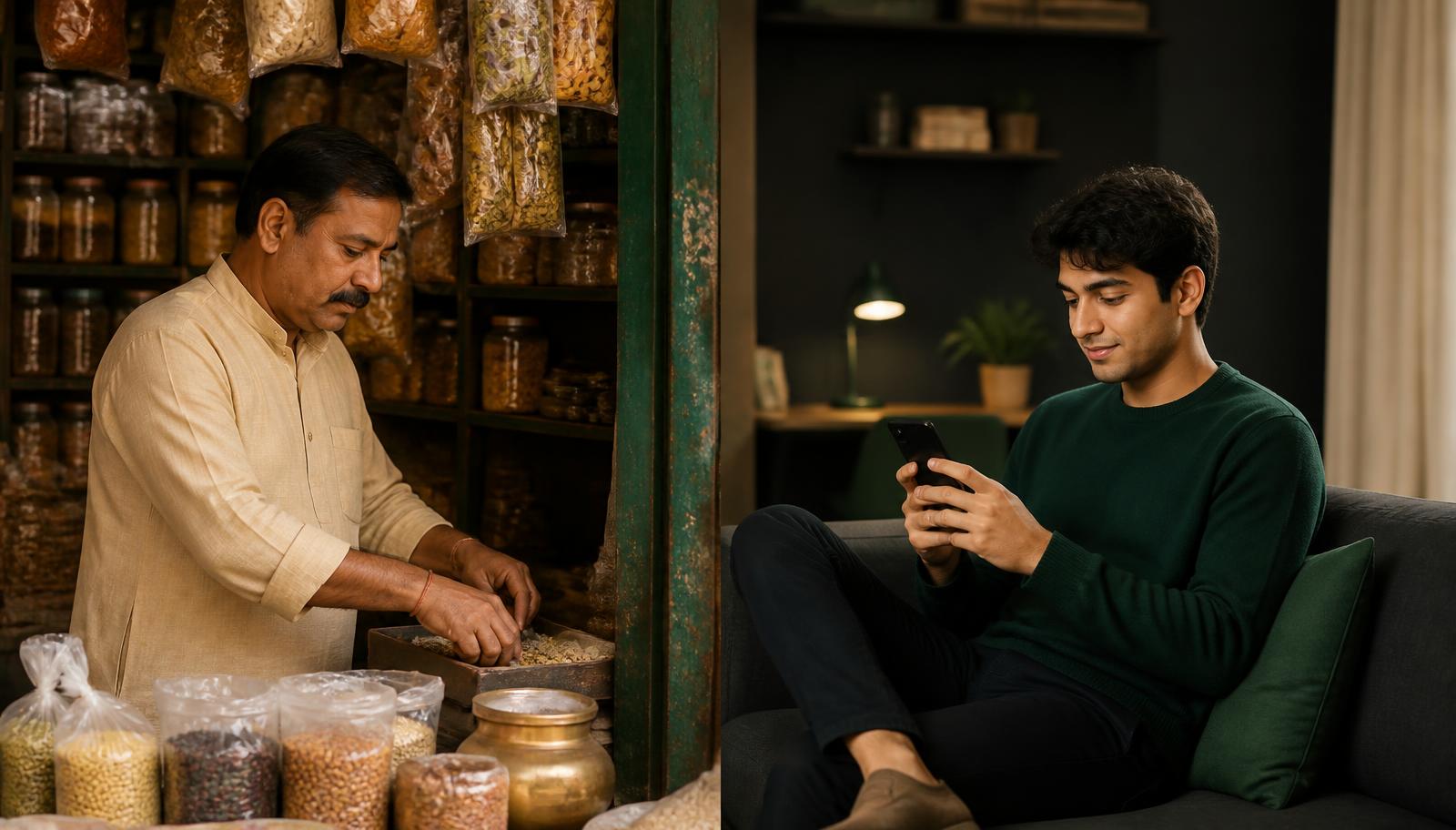
Left: a local shopkeeper arranging goods. Right: a customer browsing on a phone at home.WISEOM

The evolution of shopping

Every shift changed how people discover.

  1. 01

    Exchange

    People exchanged goods locally.

  2. 02

    Retail

    Physical stores became the centre of commerce.

  3. 03

    E-commerce

    Products became discoverable online.

  4. 04

    Quick-commerce

    Speed became a major part of consumer expectations.

  5. 05

    Hyperlocal digital markets

    The opportunity WiseOm is pursuing: making local supply digitally discoverable and accessible.

We don’t claim hyperlocal is the inevitable next stage of commerce. It is the opportunity WiseOm is pursuing.

The problem

If a shop is 200 metres away, why order from 2 kilometres away?

Imagine a customer needs a product. There is a local shop nearby that has exactly what they need. But the customer doesn’t know which shop has it, whether it is currently available, what the price is, whether the shop is trustworthy, or whether they can order it. So they open another app.

Today

Customer → searches online → large platform

The intent

Customer → WiseOm → nearby local shop

The local shop isn’t necessarily losing because it lacks supply. It may be losing because it lacks digital visibility.

Local markets are not the enemy

Local markets aren’t disappearing. They’re being disrupted.

Traditional retail remains important in India. Consumers still shop physically, and many people combine online and offline shopping. The shift is in how people discover, compare and evaluate products.

The opportunity isn’t to replace local markets with e-commerce. It is to connect local markets with digital behaviour.